
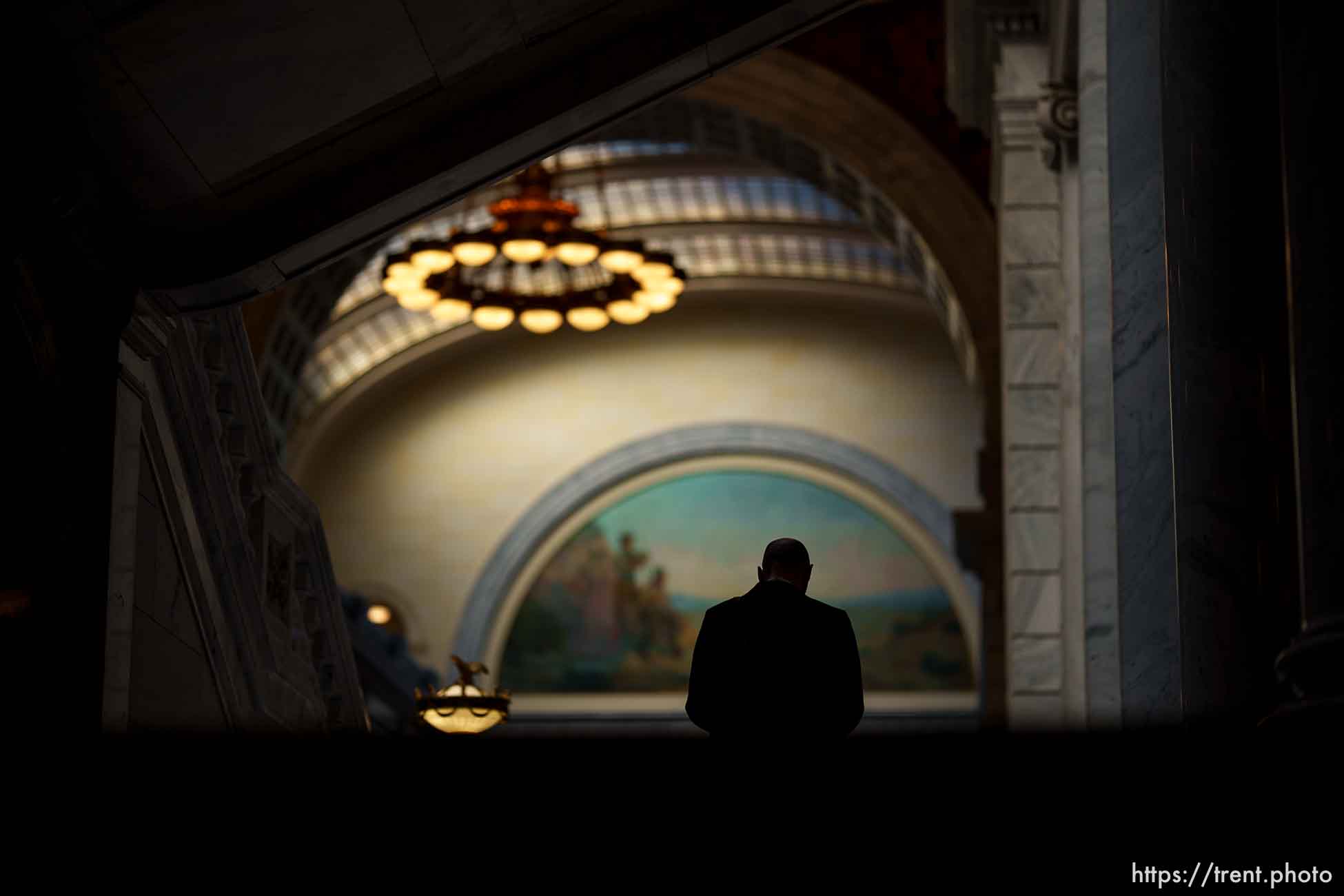
The meeting was very quick. The Utah Board of Pardons and Parole would announce their decision. Gardner would either be executed or his sentence commuted to life in prison without parole. It was very tense.

I trained my camera on the victims’ families. The Board announced its unanimous decision not to commute Gardner’s sentence. The execution would proceed.
Barb Webb, whose father was shot by Gardner, pumped her fists. Afterward, Barb’s sister Tami was interviewed in front of the prison…

From the cell block behind her, inmates began shouting. “Kill him!” “Kill him!” Their primal shouts sent a chill down my spine.
And now I’m going into the prison to cover the firing squad execution. I won’t be witnessing the actual event. I will report back after it is done.

The final witness on day one of the commutation hearing is the offender, Ronnie Lee Gardner. He’s sworn in and makes a statement, then answers questions.
His lawyer reads a letter Gardner wrote to Oprah, hoping to get her financial help in starting up a farm for neglected and abused children on some land he owns. He has a little over a thousand dollars (made from selling handmade crafts) to put into getting the farm started.

Recounting the murders his story seems to shift a bit. He says this time he’s telling the truth. He says he wants to apologize but one of the victims’ families won’t accept his apology so he hasn’t offered it.
He says he has avoided speaking out in the media to keep the families from any further hurt.

For a very brief moment (above) he is overcome with emotion, talking about the remorse he feels. He looks down and the moment is over.
Referring to a violent incident with another inmate he says, “I didn’t try to kill him. I stabbed him several times.”

Gardner’s attorney tells the board that he would prefer not to attend the remaining two sessions of the hearings. He says Gardner’s arthritis makes it too painful for him to sit in the chair with his hands chained behind his back.

After it’s over, Deputy Nick Kirk’s widow VelDean Kirk and her granddaughter Mandi Hull leave the prison.
Day one of the commutation hearing. Get to the state prison at the crack of dawn. Leave everything in the car other than my ID and the photo gear that has been previously approved. Also left in my car is a photo editor who will edit and transmit my photos.
The hearing is scheduled to go from 8am to 2pm with two fifteen minute breaks. To get photos and news out we sent in three reporters. First break, first reporter grabbed my memory cards and left the prison, dropping the cards with the photo editor and calling in an update. Second break, second reporter grabbed my cards and left. With my memory cards I sent a note that said, “Mexican for lunch.” The system worked out well and we moved fifty photos to the pool* quickly.
The first parts of the hearing were statements from the families of Gardner’s victims. Tami Stewart read a statement with her niece Mandi Hull providing support…

After the families, Psychology professor Craig Haney testified for the defense about his findings on Gardner’s upbringing. To sum it up, Ronnie Lee’s early years were a nightmare: Neglected from the start by a mother who had more than she could handle. Huffing paint and gas at age six, on drugs at age ten. Sent to a mental institution in order to provide him with a healthier environment, not because he was mentally ill. While in a state institution, he and his brother were befriended by a man who took custody of them upon their release. Authorities checking in on the situation later found the home filled with men dressed as women and the Gardner’s new guardian to be a pedophile.

As it was all detailed, I photographed Haney with members of the victims families in the background, wondering what they were thinking. Of course, this case is twenty-five years old. They’ve probably thought enough about it already.
Twenty five years. Think about it.
* Pool – on big stories a single photographer is designated the pool photographer. That photographer is the only one allowed in but shares photographs with all media outlets in the pool.
A while back I got a call from an editor who wanted to assign me to the firing squad execution of convicted killer Ronnie Lee Gardner. He asked me if I’d have any problems doing that, if it would get into my head or whatever. If I were to be a witness to this man being shot (and I’m not), would it affect me? I looked inside for some kind of feeling and found nothing. No reaction to the idea. So, “Sure, I’ll do it,” I said.
Of course, it’s naive to think that being part of the execution coverage would have absolutely no affect on you, but that was my first reaction. I have now covered several court hearings leading up to tonight’s scheduled execution.
The first assignment was to meet with the Kirk family, to tell their story. Deputy Nick Kirk was shot during one of Gardner’s escape attempts. He survived, but his health was never the same.
Another assignment was a hearing at the Utah Supreme Court, where Gardner’s attorneys were making an argument to overturn the execution. In the court you’re stuck in a corner and good shots are hard to come by. Outside after the hearing, attorneys spoke to microphones and TV cameras. I watched for a few minutes and left. In the lobby I came across a split second scene. Two widows of Gardner’s violence, VelDean Kirk and Kathy Potter, sharing a quick and emotional embrace. I only got two or three frames before it was over, and because of that the composition of the moment isn’t perfect…
I approached Mrs. Potter to ask for her name, which I didn’t know at the time. The man she was with waved me off saying, “She doesn’t want to be involved.” I was starting to back off when she said something like, It’s okay. My name is Kathy Potter. I am Melvyn Otterstrom’s widow.
To be continued…
Thelma Moriarty was a World War II bride, having married husband Bernard Moriarty just before he enlisted. Now that many WW II veterans are dying off, their wives remain as the only link to this important time in history.