Last Day for Salt City 50′s First Exhibition
Today is the last day to submit photos for the September show at the Gallivan Center.
More info: http://saltcity50.com
Today is the last day to submit photos for the September show at the Gallivan Center.
More info: http://saltcity50.com
Very excited to announce that Salt City 50 is finally off the ground.
The new project Salt City 50 is a non-profit group that puts on exhibitions of photographic prints. Our first show is coming up very quick, and will be held at the Gallivan Center September 10th in conjunction with Broadway & Opera Under the Stars. This first show is limited to Utah photographers, so this is your shot to have your work beautifully displayed before a large, sophisticated audience.
It works like this:
1. Photographers submit their work ($10 submission fee per photo).
2. Salt City 50 juries the show, has the work printed and mounted, and promotes the exhibition.
3. Photographers may price their prints for purchase. If a piece doesn’t sell, the photographer gets the print.
We have big plans for the future, and it all starts right now.
Deadline for submissions for our first show is 11:59pm Friday, August 20.
The link: http://www.saltcity50.com/

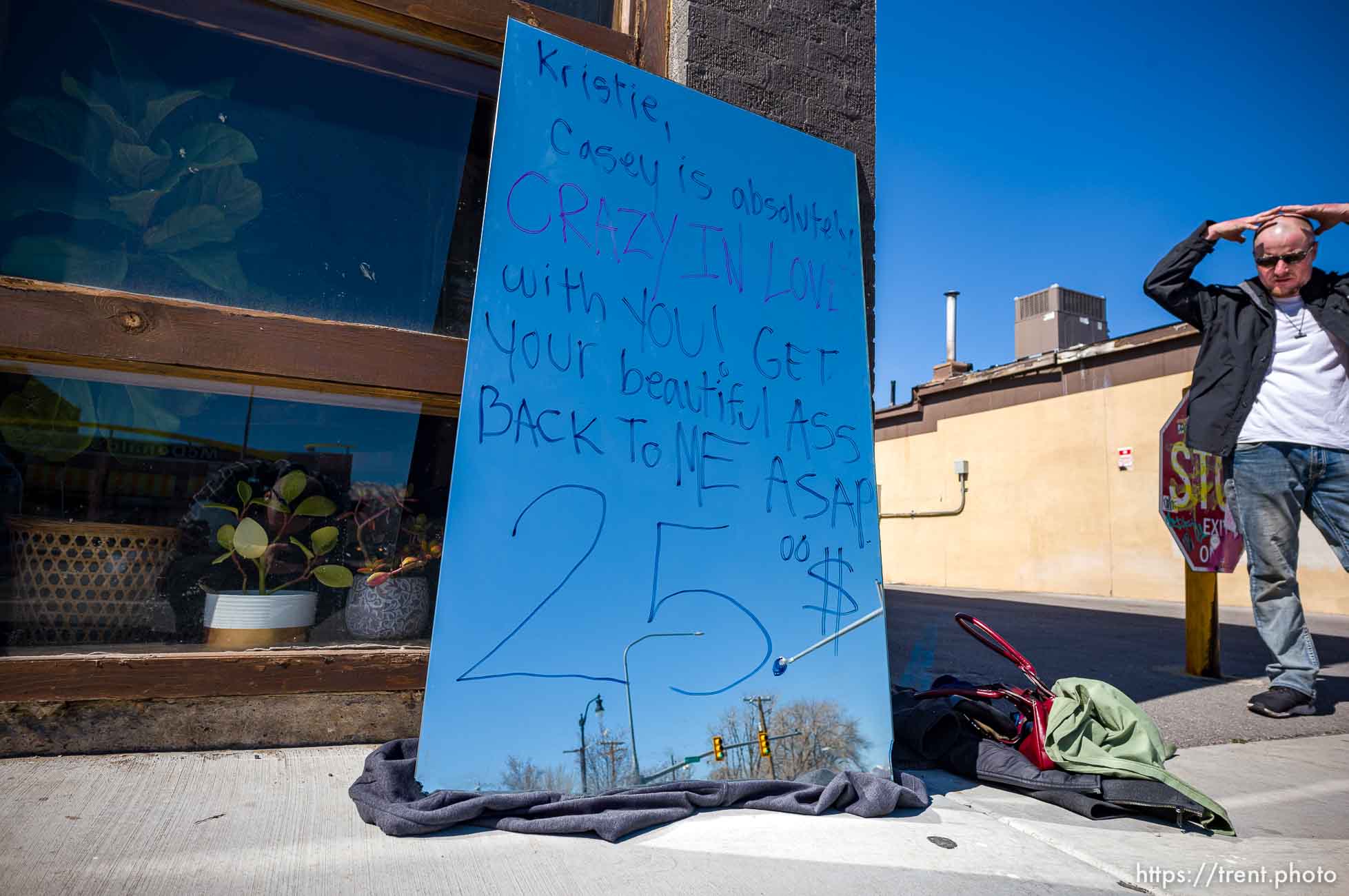
Depending on your politics… sign placement WIN or FAIL.
Stories like this are some of the worst. 26-year-old preschool teacher Kimberly Evans fell into the raging water while hiking near a waterfall in Bells Canyon a couple weeks back. A day later rescuers still hadn’t found her and I was sent out to photograph the story. The police wouldn’t let me up to photograph the search efforts so I waited at the police command post where the family was waiting for any news. I sat off in the distance with a pair of TV cameramen. We hunkered down in the shade, giving the family space during this horrible time. There were lots of emotional scenes: hugs, hand holding, and solemn faces. After a few hours we were told that the search would soon be called off, the water being too high and fast for recovery efforts. A police officer walked up the street with the woman’s parents, telling them that the search would be called off (my assumption). It’s the worst kind of news for a parent and it was heartbreaking to watch. You wouldn’t wish something like this on anyone.

That’s the full frame, shot from a distance with a super-telephoto 400mm lens. On the website and in print we cropped the photo tight, zeroing in on the emotion.
Just minutes before I took the photo above, I was talking with another photographer about how much we hated tragic events like this. How we hated to see these terrible things, and how we felt as photojournalists during times like this. It’s a huge topic that I need to write more about in the future.
This photo captured the emotion of a tragic event. It is a powerful moment, one of those things I’ve seen on this job that I’ll never forget. The kind of thing that stuns you speechless when you go home after and your spouse casually asks, “Did you have a good day at work?”
Some readers on our site felt my photo went too far. I’ll end this post with their comments, which you can agree or disagree with:
Tribune – would you please show a little sympathy and empathy…we do not see to see the sorry of the parents as they try to get through this horrendous ordeal…..PLEASE think how you would feel is this were your child.
Kind of inappropriate, trib, to show a mother’s unspeakable grief – doncha think? Privacy…
Horrified the Tribune chose to show a picture of her mother learning her daughters fate.
Is there no decency anymore? No privacy for the bereaved. Having cameras in your face while hearing what no one should have to hear. Your child is gone. Having to see yourself in the paper on the worse day of your life.THINK Tribune!
The look on her mother’s face says it all. It’s devastating to lose a child no matter how old they are. I agree that it is in poor taste for that photo to be accompanying this article. Her parents deserve a little bit of privacy during this time.
My heartfelt condolences to the family. Tragic. That photo broke my heart.
Shame on you tabloid Tribune!!! Give the parents some privacy.
Dear God: Please don’t make my death something that will feature my mother breaking down in public. I can’t imagine a more troubling thing to weigh on my soul than to have my mother share her grief with the world. I ask you for this, Lord, as I know common decency is not something you find in journalism anymore and “self-restraint” can never weigh up to the money that exploitative photos are sure to bring in. Shame on you, Tribune.
My sympathies go out to this good family in their hour of sorrow.
As a sidenote: I am usually a fan of the Trib’s journalistic efforts–but not today. This picture showing the unbearable grief of this poor mother is heart-wrenching and uncalled for. Best that this photo be left out of the public’s eye and these good people grieve in privacy.

At 4am Friday I was done covering the execution. I sat down and wrote all I could remember…
My first stop is to the media area, set up at the police academy. To get into the parking lot I have to show my press pass at a roadblock. Once in there are patrols of police roaming the parking lot.
A photog stops to chat, says he got stopped by police and asked for his press pass while just walking in the parking lot. After he leaves I go back to eating my dinner in the car. An officer peaks his head in my window looking for someone. I say I just arrived.
Minutes later another officer peaks in my window and asks for my press ID. I flash it and she asks if I have checked in. No. She says I have to check in, and she stands by my car door until I put down my food and get out of the car.
In the building I go through a metal detector and register. They put a blue sticker with the number 35 on my press pass. It’s funny how much weight people give a company issued press pass, as they are so easy to fake.
Lots of media inside fill a large gymnasium, reporters and cameras from around the world.
After a while I drive down to the prison and hit a roadblock. The guy takes my drivers license and scans through a two page list and doesn’t see my name. I assure him I must be on there. I’m the pool photographer. He re-scans the typewritten list again. On the second page he finally locates my name, scrawled in by hand at the bottom.
I pull up to the meeting place. Several officers stand at the prison entrance, silhouetted by two rows of high fence topped with razor wire. There are two vans.
The officers come over and now I’m told that I can only bring one camera, no camera bag, and I must have a lens cap on my lens. That changes things. I grab a body with a 16-35, stick a flash on top, pop in my most reliable battery and an 8 gigabyte card. It’s an uncomfortably light kit for such a big assignment.
I leave everything else in my car other than a car key and my drivers license. Those are the rules.
The other media witnesses show up. There are nine. We are taken into a small conference room with a table covered with large ziploc bags labeled with our last names. We put our ID’s and keys into the bags. We wait ten minutes. Everyone is pretty quiet. What do you talk about at this moment? I can’t think of anything. Instead, I agonize over my equipment. My reporter seems concerned until I tell him not to worry, “I’m just overthinking it.”
There are four guards. One speaks up and reads a page of instructions. It details a little of what will happen. Any last words? Then a volley. A second volley if necessary to kill.
We go through a metal detector and then are physically searched, patted down.
We board the vans, which are freshly covered in Armor All. The steps and floor and seats are very slippery. No one is injured climbing in. Then we sit in the vans for at least 25 minutes. The radio is tuned to a local news channel. We laugh as the two hosts speculate wildly about the execution. One of the guards laughs at us laughing at our poor radio colleagues.
The radio hosts report that as of 1130pm, Ronnie Lee Gardner was asleep. One of the hosts goes off on a theme of wondering what Gardner’s last dream was. In our van, eyes roll.
The vans start up and we are driven to a different part of the prison where we idle for a while near a loading area. Time passes. 1158, 1159, 1200, 1201. I watch the minutes tick off on the van’s clock radio. The radio hosts are saying, “It could be happening this very minute,” but really we’re all sitting in vans waiting to be let in.
1202, 1203, 1204
I can’t remember the exact time we got out of the vans and into the prison, at earliest it was 1205.
An officer directs me and the videographer to the side. The nine media witnesses are let in the door and go right. Then we go in and go left. Everything inside is white and gray and fluorescent lit, very institutional. There are hallways and doors everywhere, each with an officer standing by them. Me and the video guy are led down a long hallway, past numerous guards stationed by doors, past a courtyard with a basketball court (and two officers guarding it), up some stairs, down a hall and into a conference room where we are guarded by two officers. We wait, quietly. Again, what is there to talk about at this moment? There’s a typewriter in the corner, a drinking fountain, doors numbered 69 and 70 and one labeled, “showers.”
It’s quiet. I keep wondering if I’ll hear the shots. After a long while the media witnesses are brought to our room, with more guards. It is done, he is dead. I didn’t hear anything.
The witnesses sit down and start talking about what happened. They compare notes about things like Gardner’s last words and the sequence of events. They want to get it right. The hood was put on, the shots were fired, “It happened so quickly!”
Immediately there are disagreements about details. Standing at the window of the execution chamber after Gardner was shot, one reporter had drawn a sketch of the target on Gardner’s heart indicating the four bullet marks. He insists his sketch of the target is accurate, while another reporter disputes it, saying that two shots were actually on the left not the right. The other reporter defends his sketch, saying he drew it while the target was still in front of him. They continue to argue over the details of the target. Square? Circle? Oblong? Left? Right? Centered?
They all talk about how quickly it happened. The warden was talking to Gardner. Gardner says he has no last words. The warden walks out. Guns appear. Bam-Bam! Very loud, even with earplugs.
We hadn’t heard a thing in the conference room.
They debate how long it took for Gardner to die from his wounds. Two minutes? Three minutes? They have no idea but figure it was probably three. Time was impossible to track standing there at the window watching the execution.
And time in the conference room is hard to track. After at least thirty minutes we are led into the execution chamber.

It is very small. I start shooting. We approach the chair. There are four bullet holes behind it in the wood panel behind the chair.

Reporters are soon climbing all over the chair,

pointing at the bullet holes, poking their fingers in them…

Prison officials ask the reporters to step back. I photograph the chair from every possible angle. I shoot with my flash and without. From straight on, from the left, the right, close up, far away. To avoid climbing up on the contraption I reach out and hold the camera up close to the bullet holes…

I shoot from a low angle with my camera on the ground. At a certain point I’ve exhausted the scene. Around then we are asked if we have enough.
We are led back to the vans and taken to our cars. We drive quickly to the media center. A press conference takes place where the media witnesses form a panel and provide their descriptions.
The first witness to speak shows a sketch of what the target on Gardner’s chest looked like. The second witness to speak disputes the first’s sketch and describes his own.
The media witnesses, in short statements, provide a patchwork of observations about the execution. One reporter says it wasn’t as violent as they thought it would be. The execution is described as clean and clinical. The ninth witness disagrees with the rest. He says it was shocking, louder than he expected and not clinical at all. He says that contrary to how the other witnesses described it, it was a very violent act.
I went home and slept.